Tuesday, September 20, 2005

A Real Rogues' Gallery

Mr Chua Cher Yak, the Corrupt Practices Investigation Bureau's (CPIB) chief, retired on 1 July 2005 after more than 11 years on the job. He said: "Our job is driven by political will. We can only be as effective as the Government wants us to be." Last year, CPIB investigated 295 cases, and all were completed within two months, resulting in 156 people being prosecuted.

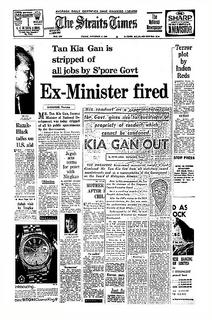
Tan Kia GanTan Kia Gan was the Minister for National Development until he lost the 1963 elections.

While a director on the board of Malaysian Airways, Tan took strong objection to the purchase of Boeing aircraft. A few days later, a Mr Lim, a business friend of Tan, contacted First National City Bank, Boeing's bankers, to offer his services for a consideration. The bank knew of the Government's strict stand against corruption and reported the matter. Lim refused to implicate Tan Kia Gan and Tan could not be prosecuted.

But then Prime Minister Lee Kuan Yew was convinced Tan was behind it, and issued a statement to say that, as the Government's representative on the board of Malaysian Airways, he had not discharged his duties beyond reproach. He was removed from the board and from all his other appointments.
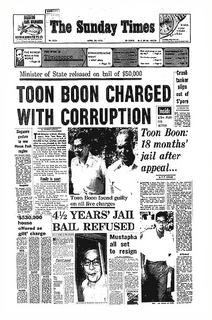

Wee Toon BoonWee Toon Boon was Minister of State in the Ministry of the Environment in 1975 when he took a free trip to Indonesia for himself and his family members, paid for by a housing developer on whose behalf he made representations to civil servants. He also accepted a bungalow worth $500,000 from this developer and took two overdrafts totalling $300,000 in his father's name against the personal guarantee of the developer, to speculate in shares.

He was charged, convicted and sentenced to four years and six months in jail. Upon appeal, the convictions were upheld but the sentence was reduced by 18 months.
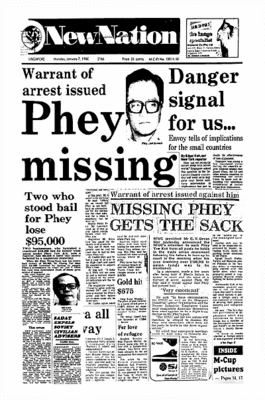

Phey Yew KokIn December 1979 Phey Yew Kok, President of the NTUC and a PAP MP, was charged on four counts of criminal breach of trust involving a total sum of S$83,000.

He was also charged on two counts under the Trade Unions Act for investing $18,000 of trade-union money in a private supermarket without the approval of the minister. As was normal in such cases, he was released on bail, but unusually he was not asked to surrender his passport.

Devan Nair, as Secretary-General of the NTUC, was close to Phey Yew Kok and believed in his innocence. He wanted the CPIB to review the case, saying that an innocent man was being destroyed on false charges. But after he read the evidence shown by the CPIB in confidence, Devan did not pursue the matter further.

Phey Yew Kok decided to jump bail, and his two sureties lost their $50,000 deposit. Some say he was last heard of in Thailand, eking out a miserable existence as a fugitive, others claim he is operating a transport company in Taiwan.
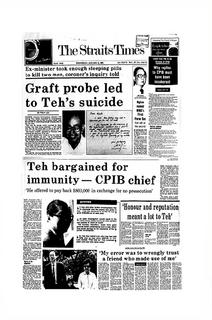

Teh Cheang WanThe most dramatic catch was that of Member of Parliament Teh Cheang Wan, then Minister for National Development, who once threatened to withhold emergency lift services from HDB wards that fail to vote for the ruling party.

In November 1986, one of his old associates admitted, under questioning by the CPIB, that he had given Teh two cash payments of $400,000 each, in one case to allow a development company to retain part of its land which had been earmarked for compulsory government acquisition, and in the other, to assist a developer in the purchase of state land for private development. These bribes had taken place in 1981 and 1982.

Teh denied receiving the money and tried to bargain with the senior assistant director of the CPIB for the case not to be pursued.

A week later, on the morning of Dec 15, Teh took a massive overdose of sodium amytal. Teh preferred to take his life rather than face disgrace and ostracism.
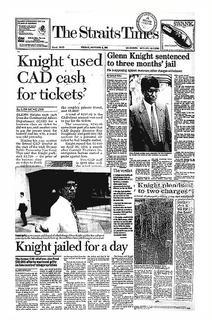

Glenn KnightIn 1991, the Director of the Commercial Affairs Department (the anti-graft and investigative arm of the Ministry of Finance) and former public prosecutor Glenn Knight Jeyasingam was charged in the subordinate court before District Judge Alfonso Ang. He pleaded guilty and was sentenced three months imprisonment for two offences.
The first charge made was essentially that Jeyasingam did attempt to cheat Managing Director of Trans-Island Bus Services Ltd Ng Ser Miang, with the intention of inducing Ng to effect an investment of Singapore $3 million in the Batam Island Fantasy Resort.
The second charge essentially was that Jeyasingam, did knowingly use, with intent to deceive the Ministry of Finance, a vehicle invoice of Ching Dtien Company, to mislead into the granting of a government vehicle loan of $65,000.

Jeyasingam joined the Attorney General's Chambers on April 3 1970 and reached the position of Senior State Counsel. On October 16 1984 he was appointed director of CAD, responsible for the setting up of the department for the investigation and prosecution of commercial crimes. In 1989 he received a strong commendation from the Minister of Finance for outstanding leadership in setting up CAD, and in 1990 he was awarded the Public Administration Medal (Gold).
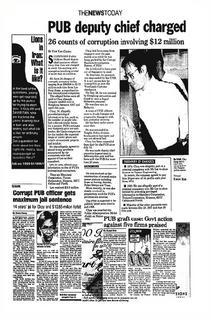

Choy Hon TimIn 1995, a senior Public Utilities Board (PUB) official was given the maximum 14 years jail and ordered to forfeit US$9.8m received as bribes in Singapore's biggest corruption case. The sentence is the longest, and the kickbacks accepted by Choy Hon Tim from local and foreign contractors over a period of 18 years, a record high, judging from past corruption cases. Choy, the former Deputy CEO of PUB received the money through former PUB clerk Lee Peng Siong who had been an Australian citizen since 1983. Lee who was a consultant to PUB paid the money for pre-received information on the PUB tenders. The scandal resulted in the barring for 5 years five well-known contractors implicated in the bribery - Britain`s BICC, Siemens, Pirelli, and Japan's Marubeni Corporation and Tomen Corporation. The ban came when BICC announced planned to expand its operations in Asia with a US$31m investment in Indonesia and the Philippines. Lee, who was promised immunity from prosecution, remained free in Australia.


Tuesday, September 13, 2005

Tough Laws

On 12th September 2005, Channel News Asia reported that two bloggers(sic) were charged with sedition for posting racist comments online.

Lawyers say the last time the sedition act was invoked in Singapore was at least 10 years ago.

25-year-old Nicholas Lim Yew and 27-year-old Benjamin Koh Song Huat were accused of posting racist comments on an online forum and on their blog site. They were both charged with committing a seditious act, by promoting feelings of ill-will and hostility between races in Singapore.

Wikipedia, the free encyclopedia, describes sedition thus:
"Critical speech, political organization, and mere association between individuals may be considered as "sedition." And though such behaviours may be common in a free society, in societies where sedition laws exist the acts and behaviours which qualify are highly subjective, and typically left to the whims of state agents. Legal definitons of sedition often include subversion of a constitution, or incitement to rebellion or insurrection toward the lawful authority. Sedition may include any commotion, though not aimed at direct and open violence against the laws."


From the perspective of the Singapore Sedition Act:

3. — (1) A seditious tendency is a tendency —

(a) to bring into hatred or contempt or to excite disaffection against the Government;

(b) to excite the citizens of Singapore or the residents in Singapore to attempt to procure in Singapore, the alteration, otherwise than by lawful means, of any matter as by law established;

(c) to bring into hatred or contempt or to excite disaffection against the administration of justice in Singapore;

(d) to raise discontent or disaffection amongst the citizens of Singapore or the residents in Singapore;

(e) to promote feelings of ill-will and hostility between different races or classes of the population of Singapore.

(2) Notwithstanding subsection (1), any act, speech, words, publication or other thing shall not be deemed to be seditious by reason only that it has a tendency —

(a) to show that the Government has been misled or mistaken in any of its measures;

(b) to point out errors or defects in the Government or the Constitution as by law established or in legislation or in the administration of justice with a view to the remedying of such errors or defects;

(c) to persuade the citizens of Singapore or the residents in Singapore to attempt to procure by lawful means the alteration of any matter in Singapore; or

(d) to point out, with a view to their removal, any matters producing or having a tendency to produce feelings of ill-will and enmity between different races or classes of the population of Singapore,

if such act, speech, words, publication or other thing has not otherwise in fact a seditious tendency.

(3) For the purpose of proving the commission of any offence under this Act, the intention of the person charged at the time he did or attempted to do or made any preparation to do or conspired with any person to do any act or uttered any seditious words or printed, published, sold, offered for sale, distributed, reproduced or imported any publication or did any other thing shall be deemed to be irrelevant if in fact such act had, or would, if done, have had, or such words, publication or thing had a seditious tendency.


Investigations into the case began after "someone" called the police hotline at the ungodly hour of 3 a.m. on June 19 to complain that Koh's blog on www.upsaid.com "discussed topics that would disrupt racial harmony".

Inquiries into that complaint led the police to an online pet forum, www.doggiesite.com, where Lim, a marketing executive, allegedly posted racist remarks.

Koh faced three charges while Lim faced two for remarks made between June 12 and June 17 this year. If convicted, they could be fined up to $5,000 per charge or jailed up to three years, or both.

According to court documents, Lim's forum message began with: "The masses are idiots. 'Nuff said". He went on to make disparaging remarks about Muslims. Then, turning his attention to the Chinese and Indians, he wrote that listening to the complaints of "Chinese and Indians ... was no less irritating". Koh was more pointed. Peppering his blog entry with vulgarities, he directed his tirade at Malays and Muslims. His blog had a picture of a roasted pig's head with "a Halal look-alike logo", according to court documents.

Dr Ang Peng Hwa, director of the Singapore Internet Research Centre at Nanyang Technological University, said someone could "technically" be charged if a racist remark was overhead and reported to the authorities.

"(But) only when the audience size is large enough will the impact of the statement be meaningful," said Dr Ang.

"Many bloggers do not know the law, unlike trained journalists. People assume there is a cloak of secrecy. But you can still track people down. There are a lot of remarks out there (on the Internet) that are defamatory, inflammatory racist remarks. These are not taken seriously in many parts of the world," said Dr Ang. "They are seen as rants and people usually ignore them."

"Singapore is an unusual case."

The source of the hubris stems from a letter written to the Forum pages of the Straits Times:

UNCAGED PET SEEN IN TAXI

ON JUNE 3, while I was on a bus, I noticed a taxi with a small dog in it.

The dog was not in a cage and was standing on the backseat beside its owner.

I am curious to know if cab companies allow uncaged pets to be transported in taxis. Dogs may drool on the seats or dirty them with their paws.

Zuraimah Mohammed (Mdm)

Readers were told by the newspaper with circulation exceeding 100,000 that Madam Zuraimah's concerns had a religious basis. Ustaz Ali Haji Mohamed, chairman of Khadijah mosque, was quoted as saying: "There are various Islamic schools of thought which differ in views. But most Muslims in Singapore are from the Syafie school of thought. This means they are not allowed to touch dogs which are wet, which would include a dog's saliva. This is a religious requirement."

Aftermath:
On Oct 7, Benjamin Koh Song Huat,, 27, was sentenced to a month's imprisonment while Nicholas Lim Yew, 25, was fined $5000 and jailed for a day, both for posting comments alledgedly attacking the Muslim ethnic Malay community.

Benjamin's online problems started after a trip to East Coast Park in June when he was walking his dogs and had a run-in with some Malay families, who shy away from dogs on religious grounds. He went home later that day and "blasted away" on his blog, and supposedly advocated desecrating Islam’s holy site of Mecca in his online journal. Then came the Internet community's reaction.

"People started posting comments and made nasty remarks about me and my parents. I thought it was another blog war and I didn't really bother," he said. "But the comments didn't stop." Eventually, Koh locked his blog a week later to prevent anyone from posting comments and put up an apology.

It appeased some — but there were others who were still baying for blood. At the end of June, plainclothes police officers went to his home to question him, after a 21 year old female Malay media executive, who subsequently spoke to the press under the pseudonym of "Kalin", dialed 999 to lodge a complaint.

Koh maintained during a 40-minute phone interview that he was not a racist. He said he has many Malay friends from his days at Swiss Cottage Secondary School. So, when news of his arrest broke, he got calls from one of them. "They called me, laughed and said: 'You racist? Come on lah'," said Koh. His friend IT manager Mohammad Hisham Bin Abu Bakar accompanied him to the court sentencing.

Two days before the Muslim new year celebrations of Hari Raya, Koh told Today about the three weeks in his 2m-by-4m jail cell: "I was having a panic attack and it took two officers to calm me down. The psychological relief was the window above my cell."

The former kennel keeper was so nervous that he flushed down the toilet the six slices of bread given for his first meal. He had no appetite and just wanted to sleep. What ate into him were not only the four walls but fear. He was worried about how the Malay prison officers would treat him.

Though by nature a jovial and outgoing man, he made it a point to avoid interacting with other inmates. Kept in solitude, Mr Koh said he only came out of the cell to shower or to borrow books to read. Prison officers nicknamed him "The Blogger" and those who did not read his blog wanted to know what he had written.

Regaining his freedom, however, is not the close of the chapter for Mr Koh, who blogged for the first time after a four-month break the night he was released from Queenstown Remand Prison. In a short entry, he informed his friends of his return to cyberspace. "I now feel demoralised about writing. The feeling (to write) is there but I have to censor myself. Freedom of speech here is a very debatable term. I don't think I am one to censor myself, though of course I must be more careful now."

"I have been punished and it's time to move on," he said. "The racist label was what I hated. I am not a racist. I am not Pauline Hanson or Hitler. But the label will stick with me. I probably will take some time to get over it."

Quite understandably, when his Malay friends invited him to the Hari Raya gatherings at the coming weekend, he said "no".

"I want to go but their relatives will be there. Our generation can understand my situation but I will still feel embarrassed with their relatives around," he explained.