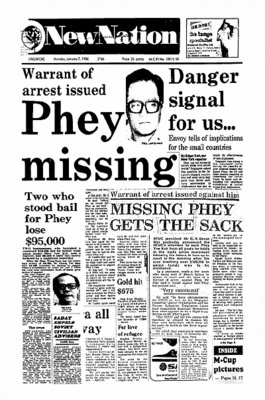
 Tan was the student leader of the University of Singapore Student’s Union (USSU) in 1975 when he was caught up in the workers’ labour problems at American Marine. His nemesis was Phey Yew Kok, Secretary General of Pioneer Industries Employee’s Union (PIEU). Tan found himself jailed for 6 months for 'rioting' even though he was nowhere near the office where he was supposed to have 'broken some chairs' -- but the word of Phey Yew Kok, then PAP MP, now a fugitive in Taiwan, carried the day. The judge chose to believe Phey.
An Australian Queen's Counsel, Frank Galbally, who observed the trial for the Australian Union of Students, said: "In Australia, the case would be laughed out of court ... the evidence and procedure ... would, in my opinion, have aborted any trial in Australia ... [The three accused] did not get a fair trial. ... In my opinion, it is just a political trial."
Tan is now a partner of a law firm. The British national lives with his wife and 19-year-old son in London. He keeps in touch with Singapore politics through the Internet and visits the region often, usually to meet his 92-year-old mother, who lives here.
Extracted from USSU publication, “Awakening”, Issue 25, Tuesday 4th Feb 1975
36th Day of the Trial 3rd Feb 1975
Seow Yuet Leng a worker from Eminence Factory and a temporary representative of the PIEU branch, was testifying for the defence and told the court what she saw inside the PIEU premises on 30th Oct 1974.
On the 29th noon she was told by the secretary at Eminence that the Union called her and asked her to go for a meeting on the 30th October. She asked Lai Ah Choon on the night of 29th to accompany her there.
“When we reached PIEU at about 10.45 am I saw about 100 people in the field. Lai saw a Chinese male friend and went over to talk to him. I sat on the bed. After about 10 minutes she came over to sit on the flower bed. 5 minutes later we saw that the crowd had gathered in the field. We went up but could not hear what they said because we did not join them.”
“I went round the crowd once, then I held Lai by the hand and asked her to go into the premises. We then released our hands. When we reached the door I saw Robert Leow at the door. We were asked to go in.
When I went in, Lin Chin Siew asked why I was with those people in the group, and then Robert Leow had asked me to go in. We went into A department, Robert Liew went in first, followed by myself and then Lai.
Robert Leow told me that he went to the Ministry of Labour on the previous day. He said that he met Mr Leow there and he did not promise the $40 increase. He only promised an increase of 10%. He said that he was not sure whether the 10% will be added to the basic pay or on that with the extra. Confirmation of this increase could be made after the manager’s father return from America. He did not know when he will return from America.”
“Then there was a sound from outside – someone closing the door. Following this there were people knocking at the door. The door was knocked twice or thrice, pause then knocked 2 or 3 times, pause and carried on that way.
Then a person walked into the passageway. He walked a little faster than normal. Robert Leow stood up. He told us to wait for a while and he went out. He went up to the Hall. I also saw Lawrence Quek walking in that direction, to the hall. I then came out with Lai. While walking to the hall along the passage way, I saw Kwek listening into the phone in the passage way. Lai was just behind me. I wanted to go into the hall and I pulled the door a little. Kwek had his body leaning against the opened door.”
WP: Before you came out of department A, did you see any of the accused persons?
YL: I did not.
WP: Did you see me while walking along the passageway to the hall?
YL: I did not.
WP: Did you see anyone carrying a stick along the passageway?
YL: I did not.
When asked, Yuet Leng said that Kwek was then leaning over the counter phoning with his shoulders bent beside me.
"I had just stood still when Lawrence Kwek stood beside me. At that time the door had come closed. We were all in the hall.
After Lawrence Kwek came in to stand beside me, he said something in English. I did not understand what he said. He then punched the glass on the door with his right hand and shook his hand from the wrist a few times.
He then said, “Overturn the tables and chairs” and he himself overturned a table with his left hand. We stood there for a while. Lawrence Kwek wanted them to go in. They went in.
At that time I was very frightened. I heard “pomp” once and saw a person kicking the glass from outside."
WP: Other than Lawrence Kwek, were the tables overturned by anyone else?
YL: Yes.
WP: (Where) was Robert Leow and Lin Chin Siew at that time?
YL: They were in the hall too.
“I spoke in Lai in Cantonese that if she doesn’t run, I will run. I then ran out to the door, opened it and walked out.”
WP: Did you notice anything on the floor of the hall as you ran towards the door?
YL: Yes. The overturned tables and chairs. There were also pieces of paper.
“I went to the left after I had crossed the drain. When I was in the field, a Chinese man in his 20’s approached me. He said, “Miss, can I take a picture as a souvenir?” I scolded him. “You don’t take. What picture do you want to take.” He smiled and walked away.
“A few girls came up. One girl (she identified as Kim Hong, one of the USSU students) asked me what happened. I was too frightened and did not say anything immediately. Lai told them that he was the Assistant General Secretary. The short girl asked, “Why did they want to break it like that?” She added, “It appears to me they want to falsely accuse the workers with this matter.” I said, “I don’t know.”
“While we were there another middle-aged man came to talk to us. He left the site at about 12.55 pm.”
“At about 1 pm I went back to work. I spoke to four or five workers and told them about the event at PIEU that morning.”
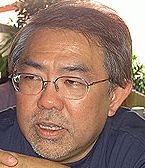 WP requested for these 4 workers to be his witnesses.
Judge: If you are interested in staying till February, it’s your business.
SG: I object. He is calling these stupid and useless witnesses of his defence to prolong the trial because he knows that he had not handed in his assignments and that he is going to fail.
Raman (lawyer for one of the defendants) strongly protested. He said that these witnesses referred to by Wah Piow were also his witnesses and as such the SG’s suggestion was unfair.
The Judge said he will decide on this later.
Yuet Leng named the four girls as Wu Ching Ying, Wong Chin Liang, Chen Siew Fong and Lee Pui Liang.
“I told them that the Assistant General Secretary at AUPE, Lawrence Kwek broke the glass with his hand. I also told them that after he overturned the table he asked the union officials to overturn the tables and chairs. Lee asked me why they did all those things and I told them them I did not know and that I was very frightened at that time. I also told them about the 10% wage increase.”

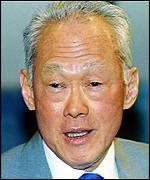 The thesis claims to be an attempt to "advance their understanding of Singapore's idiosyncratic version of multiracialism by casting new light on the thinking of its primary architect, Mr Lee Kuan Yew."