Thursday, September 08, 2005

White Elephants

Singapore tabloid "Today" reported that growing public reaction over the authorities' investigation into the "white elephants" episode has compelled the police to justify their ongoing actions. What is significant here is the comparative lack of public reaction over the overwhelming police response to the 4 person protest held outside the CPF building recently.

In a statement issued yesterday, 7th September 2005, the Singapore Police Force (SPF) said "the Police must be fair and transparent at all times and not investigate cases selectively".
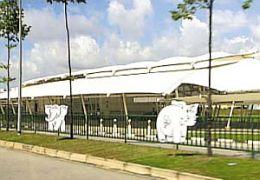
Idle since 2003 - Buangkok StationThe statement went on to explain that because someone had called "999" to complain about the animal cut-outs displayed on July 28 outside the Buangkok MRT station, the police had to determine whether any offence had been committed under the Public Entertainments and Meetings Act.

The placards, stuck along the road divider outside the train station operated by SBS Transit, were taken down on the very same day — after Minister for Community Development, Youth and Sports Vivian Balakrishnan visited the Punggol South constituency and caught the implicit message that residents would like to see Buangkok station open after two years of waiting. Commented Dr Balakrishnan, "Let me say that your message is taken, you don't need to convince me. I understand your wish to have the station open, I understand your frustration -- the thing is ready and yet the gate is not open but the PM has said two or three years, Mr Yeo Cheow Tong has said that once you have 2,000 units. It's just a matter of time."

Transport Minister Mr Yeo showed how the fine line is drawn in policy making: "I have said that when the number of units there reaches 2,000 to 3,000, we would open it. Today, within the 400m radius, there are only something like 600 units. So, it's well below. But, of course, if you extend the radius to 500 metres, we get close to 2,000. So I have asked the LTA, 'between 400 to 500 metres, is the cut-off so precise? What happens if we pull the line to 500 metres?'"

The minister seem to be blissfully ignorant of the Marina Bay Station operating at the end of the North South line in desolate Marina South, with nary a housing unit in sight. Completed in 2003, Buangkok Station is still not operational, the official reasoning being that there are not enough commercial or residential developments within 400 metres of the area.

Since the police began doing their job, several Singaporeans have written in to express their surprise at the police's decision to conduct a full-fledged investigation as a result of just one caller's complaint. The police action at the CPF building was also initiated by a phone call to the police.

More than 10 people, including residents and grassroots leaders, have been questioned since the police started their investigations last week, sources told Today.

If the police do determine that a crime has been committed, they may refer the case to the Attorney-General's Chambers, which guides law enforcement agencies on their investigations besides prosecuting criminal matters in court.

Under the Public Entertainments and Meetings Act gazetted in 2001, entertainment accessible to the public should not be carried out in a manner that is indecent, immoral, offensive, subversive or improper.

In addition, exhibits may not be put up in public without a permit. The offence carries a maximum fine of $10,000.

It should be pointed out that, as Presidential hopeful Andrew Kuan found to his chagrin when he reported a case of forgery, when a matter has been brought to the attention of the police, latter may, after investigating, close the case without persecution and no explanation given to parties involved.

Punggol South MP Charles Chong ventured further to predict that a feedback forum may be in order as soon as the case is closed so that residents can air their views on the issue. He appeared highly conversant about how the system works.

Chong said that complaints from residents tapered off in 2003, but flared up again recently when the transport fare hike was announced.

Said Mr Chong, "The bus fare went up, ERP gantries went up -- it sort of resurrected a lot of their frustrations … Every day when they see the site and not being able to use it and incurring higher transport costs for a station that's further away, I think this has irritated quite a lot of them."

For a parliamentarian of many years' standing, Chong had a curious perspective of law and order in the well disciplined city: "Throughout this whole experience, there are some who feel the letter of the law should be observed. Others feel there can be some easing of rules."

Aftermath:
In a statement to the media on Oct 6th, the police said that while the investigation into the "white-elephants" incident established that there was an infringement of the Public Entertainments and Meetings Act, it noted that "the placards did not cause public annoyance or nuisance". Under the Act, an offender can be fined for up to $10,000 for putting up exhibits in public without a permit. After "considering the circumstances", the police decided to issue a "stern warning" to the offender.

Grassroots leader Sunny LeowUnperturbed by the admonishment, Sunny Leow, 54, who chairs the Punggol South Citizens' Consultative Constituency, challenged the 999-caller who complained about the cut-outs to come forward. "We want to know why he was offended and say sorry," he was quoted as saying. His MP Charles Chong told the press his "insurgents" will gather in Bangkok for their annual retreat where, as he quipped, "white elephants are revered."

Recently, Deputy Prime Minister Wong Kan Seng, who helms Singapore's Home Affairs Ministry, had made it clear that the law cannot be selective: "We cannot apply the law to some and turn a blind eye to others. If we do, then the law becomes the real white elephant."


Friday, August 19, 2005

8 Days In August

5th August, Friday
The political establishment turned decidedly less cordial after Andrew Kuan, a card carrying member of the ruling People's Action Party (PAP) who served five terms as a town councillor and finance committee chairman at Pasir Ris-Punggol Town Council, declared himself as a contender in what had been seen as a second-term shoo-in for the 81-year-old government-backed incumbent, S.R. Nathan, a former internal security chief.

Almost daily since Kuan's name was first mentioned by the Straits Times on Friday 5 August, Singaporeans were been treated to an uncomely spectacle – one lone man in the cross-hairs of the political machinery coming out with all guns blazing, almost as if they were in panic mode.

PAP politicians and the media alike badmouthed Kuan in a feeding frenzy. He was described as arrogant, too full of himself, and then dirt was dug up by the New Paper about events at a condominium management council. Mr Kuan claimed that some members had an "axe to grind" after he had made an "unpopular decision" to get another committee member removed.

Kuan was 51, Chinese, and showed up to submit his papers for eligibility with the former Archbishop of the Anglican Church in tow. Immediately, he was attacked in the press by the incumbent's supporter as playing the race card.

Andrew Kuan had to obtain a COE – not a certificate of entitlement to buy a car, but a certificate of eligibility – before he can stand for election.

The committee determining eligibility had to decide firstly, whether his job (2001 - 2004) as the Group Chief Financial Officer (CFO) of Jurong Town Corporation (JTC), which Kuan says has $11 billion in assets, is equivalent to management experience leading a company with at least $100 million in paid-up capital – one of the statutory requirements for eligibility.

Secondly, whether he is a person of "good character and standing" – the other statutory condition.

Aside from the Certificate of Eligibility, all potential candidates had to submit a deposit of S$37,500 on Nomination Day. A Political Donation Certificate issued by the Registrar of Political Donations was also needed. This is required under the Political Donation Act, which seeks to prevent foreigners from interfering in Singapore's domestic politics through funding of candidates and political associations.

7th August 2005, Sunday
Firing the first salvo, the Straits Times reported that some grassroots leaders Kuan had worked with described him as "conceited". Minister Lim Swee Say was quoted by the Sunday Times as saying that Singaporeans should not hope for a contest in the presidential election just for the sake of it. Singaporean media reported extensively on the circumstances surrounding Kuan's departure from his condominium's management council in 2001.

9 August 2005, Tuesday
Even Singapore Prime Minister Mr Lee Hsien Loong chimed in and called for all candidates to be open about about their records, so that Singaporeans can make a informed judgement on them. Prime Minister Lee said he didn't know Mr Kuan well but he hoped Mr Kuan will be open about his employment history.
"I'm quite sure he will want to tell Singaporeans all about it. How he came to take up these jobs and in some cases, changed them very quickly and what the reason was. I think if I were him, I would also encourage his employers to come forward, speak freely and tell Singaporeans what they know about him," said PM Lee.
On the incumbent, Mr Lee made clear his desired outcome by saying he had no doubt that Mr Nathan had the full support and confidence of Singaporeans in the last six years of his first term. And he was glad that Mr Nathan had put himself forward for a second term in office. Nathan's personal comment on the subject in April (see below) seemed to vanish into thin air.

11th August, Thursday
Right on cue, Jurong Town Corporation (JTC) a called a news conference to provide details on the circumstances leading to Mr Kuan's resignation in July last year. It was claimed that Andrew Kuan was asked to leave JTC Corp as the board was not satisfied with his job performance.
Chong Lit Cheong, CEO of JTC Corp and government scholarship holder, said: "Quite a fair bit of hand holding is required and as a leader, CEO, I cannot be hand holding all my directors."

According to Chong:
- 51-year-old Andrew Kuan was appointed JTC's group chief financial officer in June 2001;
- After his first year, JTC was not satisfied with his performance but gave him another chance;
- Things did not improve and Mr Kuan was asked to resign in September 2003.
- He asked for an extension till March, but later made a request to stay on and serve his three-year term;
- Come June, he still did not resign and was given the ultimatum to do so or face termination;
- He finally tendered his resignation in July - after 37 months with JTC.

In response, Kuan put on record that he had worked at JTC Corporation for 37 months, extending his contract several times, and he was given performance bonuses and a raise during this period.

During his tenure with the statutory board, he was invited to sit on the editorial board of advisers for CFO Asia, a finance magazine published under The Economist Group. The magazine's managing editor, Mr Justin Wood, described his two-year working relationship with Mr Kuan as "very positive, very useful and constructive".

12th August, Friday
Meanwhile, water treatment company Hyflux, where Kuan worked as the regional chief financial officer for Hyflux-Isithmar's Joint Venture in the Middle East, released a statement saying ''We would definitely not have offered him the position if we had known of his personal ambitions. We are disappointed that he was not honest with us and have taken us for a ride.''

The Presidential Elections Committee called for JTC's assessment of Mr Kuan - which was submitted on Thursday 12th.

13th August, Saturday
Presidential Elections Committee rejected his application for a Certificate of Eligibility claiming that his seniority and responsibility as JTC's Group Chief Financial Officer were, in the opinion of the Committee, not comparable to those required under the Constitution.

Under the Presidential Elections Act, the decision of the Presidential Elections Committee in awarding the Certificate of Eligibility is final, and is not subject to an appeal or review in court.

Game Over
Garry Rodan, Director of Murdoch University's Asia Research Centre in Australia, said the government's response to Kuan's bid throws into question its promise for greater openness.
"If he is deemed ineligible for the contest in spite of a lack of any wrongdoing on his part, then the government displays a complete lack of confidence in the Singapore people to judge for themselves," he said.

Back in 14th April 2005, Chinese Daily Muzi News (LatelineNews) wrote:
The retirement of 81-year-old S.R. Nathan by the end of his term in August would pave the way for elections for the post, whose significance is often debated in a country dominated by a single party since independence in 1965. When asked by reporters whether he would stand for re-election Nathan, a former ambassador to the United States, expressed his wish to retire.
"I'm 81, you know? Everybody is speculating. I'm not speculating. I'm hoping to look into retirement," Singapore's Straits Times newspaper quoted Nathan as saying in Malaysia.
Nathan's health report card reveals he is diagnosed with diabetes, hypertension, elevated cholesterol level, prostatic enlargement and diverticulosis of the colon.