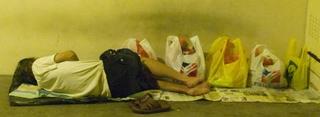
11 Aug 05, Source:www.infoshop.org
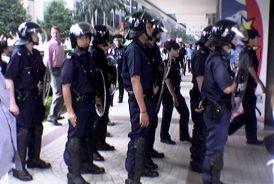 “This section go to the right! The rest go left! No one is to come through!” barked the corporal to his men, clad in full riot gear – truncheons, shields, head gear, and shin guards.
The threat? Four (yes, 4) activists who had assembled outside the Central Provident Fund Building in downtown Singapore to protest against the non-transparent and non-accountable nature of the way the Singapore Government deals with public funds. Two of the protesters were women.
The number of police officers numbered at approximately 40.
Mr Charles Tan, Ms Chee Siok Chin, Ms Monica Kumar, and Mr Yap Keng Ho were wearing T-shirts with the words: “NKF” (National Kidney Foundation), “HDB” (Housing De
velopment Board), “GIC” (Government of Singapore Investment Corporation), “CPF” (Central Provident Fund), “Financial Reserves” – “Be Transparent Now!”
These state-run organisations (NKF is closely associated with the Government) are run in a secretive manner. For example, the GIC (chaired by Mr Lee Kuan Yew, former prime minister and paramount leader of Singapore) uses the country's financial reserves in investments all the world but refuses to give an account for its dealings.
Associate Professor Mukul Asher at the National University of Singapore noted about the funds invested by the GIC: “There is…no transparency or public accountability concerning where these funds are invested.” The Asian Wall Street Journal remarked: “Where do the CPF funds go? No one is exactly sure since the government, amazingly, won’t give the public a precise accounting of how it uses the public’s money.”
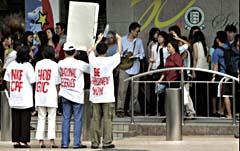 The protest started off with the four activists standing quietly outside the building wearing their T-shirts. After about 30 minutes, two police cars arrived with lights flashing, carrying a few senior officers.
This was followed by a few police vans carrying uniformed officers, including those from the riot squad. After forming up, the officers cordoned off the entrance to the building.
“Who's in charge?” Deputy Superintendent Dominic John Baptist asked the protesters, his hands quivering.
“All of us,” replied Mr Yap Keng Ho.
“I'm ordering all of you to disperse.”
“On what grounds?” asked Ms Chee Siok Chin.
“Public nuisance. Someone called to complain,” the DSP replied.
“But as you can see , we are standing here peacefully and we have not...” Ms Chee started to explain.
“Disperse now! Are you going to be here? Leave!” ordered the officer.
“Sir, can I ask you under what law...” Ms Chee persisted.
“The offence is public nuisance under the Miscellaneous Offences Act. It is a seizable offence, which means you may be arrested.”
The protesters complied and left the area. The police continued to follow them and after a few metres, stopped them and confiscated the T-shirts they were wearing.
“Will we get the T-shirts back?” the protesters enquired. The police didn't bother to reply.
Several questions need to be asked from this episode :
One, did the police have the right to order the protesters to leave especially when there were only four of them? The law clearly states that only five or more people gathered in a public place constitutes an illegal assembly.
Two, did the police see the protesters creating a commotion and making a nuisance of themselves? Throughout the protest all four protesters stood silently until the police started questioning them.
Three, why is the Singapore Government so afraid of four peaceful protesters that it had to send in the riot squad? Signs of insecurity perhaps?
Although the foursome was dispersed by the officer accusing them of causing a public nuisance, a reading of the law would seem to say they did no wrong:
Nuisances
11. —(1) Any person who commits any of the following offences shall be liable on conviction to a fine not exceeding $1,000:
(a) without authority in the case of public property, or without the consent of the owner or occupier in the case of private property, affixes or causes to be affixed any advertisement, bill or notice, or any paper against or upon any building, wall or fence, or writes upon, defaces or marks any such building, wall or fence with chalk or paint, or in any other way;
(b) bathes or washes himself, or any other person, animal or thing on any public road, or in, upon or by the side of any public tank, reservoir, watercourse or stream;
(c) obstructs or causes trouble or inconvenience to a person bathing at any place set apart as a bathing place by wilful intrusion, or by washing any animal at or near that place, or in any other way;
(d) being the owner or person in charge of any animal does not, if the animal dies, dispose of its carcase in such a way as not to be a common nuisance;
(e) places any dead animal on or near any public road;
(f) spits in any coffee shop, market, eating house, school house, theatre or public building, or in any omnibus, railway carriage or other public conveyance, or on any wharf or jetty, or in any public road, or on any five-foot way or sidewalk of any public road, or in any other place to which the public has or may have access;
(g) suffers to be at large any unmuzzled ferocious dog or other animal, or sets on or urges any dog or other animal to attack, worry or put in fear any person or animal.
Listen to what Lee Kuan Yew in 1956, speaking as an opposition PAP member, said to then Chief Minister David Marshall:
"Repression, Sir, is a habit that grows. I am told it is like making love-it is always easier the second time! The first time there may be pangs of conscience, a sense of guilt. But once embarked on this course with constant repetition you get more and more brazen in the attack. All you have to do is to dissolve organizations and societies and banish and detain the key political workers in these societies. Then miraculously everything is tranquil on the surface. Then an intimidated press and the government-controlled radio together can regularly sing your praises, and slowly and steadily the people are made to forget the evil things that have already been done, or if these things are referred to again they're conveniently distorted and distorted with impunity, because there will be no opposition to contradict."

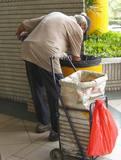 "This careful attention to meeting the physical and material needs of the population is matched by equal care and concern for the people's social and spiritual needs. In this, however, Singapore has consciously moved away from the welfare-state prescriptions of OECD societies. There are no homeless, destitute or starving people in Singapore. Poverty has been eradicated, not through an entitlements program (there are virtually none) but through a unique partnership between the government, corporate citizens, self-help groups and voluntary initiatives. The state acts as the catalyst--matching financial support, sponsoring preventive and social care, and ensuring that basic needs are provided for. Remarkably, the poorest 5 percent of households have about the same levels of ownership of homes, television sets, refrigerators, telephones, washing machines and video recorders as the national average. Perhaps this, combined with the tough law-and-order regime, explains why Singapore has one of the lowest crime rates in the world."
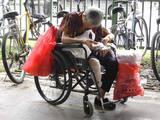 Thus there is this myth that Singapore is a rich country and its citizens are well-taken care of. Nothing could be further from the truth. The 1998 United Nations Human Development Index showed that Singapore ranked 28 on the list behind countries like Barbados and Malta.
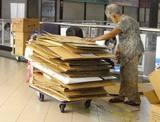 In 1990, the richest 10 percent of households earned 15.6 times more than the poorest 10 percent. (Households with no income-earners are excluded from this category.) By 2000, the gap widened: the richest 10 percent earned 36 times more than the poorest 10 percent. The average household income of the bottom decile decreased by 48.4 per cent, while the overall decrease was only 2.7 per cent.