5th August, Friday
The political establishment turned decidedly less cordial after Andrew Kuan, a card carrying member of the ruling People's Action Party (PAP) who served five terms as a town councillor and finance committee chairman at Pasir Ris-Punggol Town Council, declared himself as a contender in what had been seen as a second-term shoo-in for the 81-year-old government-backed incumbent, S.R. Nathan, a former internal security chief.
Almost daily since Kuan's name was first mentioned by the Straits Times on Friday 5 August, Singaporeans were been treated to an uncomely spectacle – one lone man in the cross-hairs of the political machinery coming out with all guns blazing, almost as if they were in panic mode.
PAP politicians and the media alike badmouthed Kuan in a feeding frenzy. He was described as arrogant, too full of himself, and then dirt was dug up by the New Paper about events at a condominium management council. Mr Kuan claimed that some members had an "axe to grind" after he had made an "unpopular decision" to get another committee member removed.
Kuan was 51, Chinese, and showed up to submit his papers for eligibility with the former Archbishop of the Anglican Church in tow. Immediately, he was attacked in the press by the incumbent's supporter as playing the race card.
Andrew Kuan had to obtain a COE – not a certificate of entitlement to buy a car, but a certificate of eligibility – before he can stand for election.
The committee determining eligibility had to decide firstly, whether his job (2001 - 2004) as the Group Chief Financial Officer (CFO) of Jurong Town Corporation (JTC), which Kuan says has $11 billion in assets, is equivalent to management experience leading a company with at least $100 million in paid-up capital – one of the statutory requirements for eligibility.
Secondly, whether he is a person of "good character and standing" – the other statutory condition.
Aside from the Certificate of Eligibility, all potential candidates had to submit a deposit of S$37,500 on Nomination Day. A Political Donation Certificate issued by the Registrar of Political Donations was also needed. This is required under the Political Donation Act, which seeks to prevent foreigners from interfering in Singapore's domestic politics through funding of candidates and political associations.
7th August 2005, Sunday
Firing the first salvo, the Straits Times reported that some grassroots leaders Kuan had worked with described him as "conceited". Minister Lim Swee Say was quoted by the Sunday Times as saying that Singaporeans should not hope for a contest in the presidential election just for the sake of it. Singaporean media reported extensively on the circumstances surrounding Kuan's departure from his condominium's management council in 2001.
9 August 2005, Tuesday
Even Singapore Prime Minister Mr Lee Hsien Loong chimed in and called for all candidates to be open about about their records, so that Singaporeans can make a informed judgement on them. Prime Minister Lee said he didn't know Mr Kuan well but he hoped Mr Kuan will be open about his employment history.
"I'm quite sure he will want to tell Singaporeans all about it. How he came to take up these jobs and in some cases, changed them very quickly and what the reason was. I think if I were him, I would also encourage his employers to come forward, speak freely and tell Singaporeans what they know about him," said PM Lee.
On the incumbent, Mr Lee made clear his desired outcome by saying he had no doubt that Mr Nathan had the full support and confidence of Singaporeans in the last six years of his first term. And he was glad that Mr Nathan had put himself forward for a second term in office. Nathan's personal comment on the subject in April (see below) seemed to vanish into thin air.
11th August, Thursday
Right on cue, Jurong Town Corporation (JTC) a called a news conference to provide details on the circumstances leading to Mr Kuan's resignation in July last year. It was claimed that Andrew Kuan was asked to leave JTC Corp as the board was not satisfied with his job performance.
Chong Lit Cheong, CEO of JTC Corp and government scholarship holder, said: "Quite a fair bit of hand holding is required and as a leader, CEO, I cannot be hand holding all my directors."
According to Chong:
- 51-year-old Andrew Kuan was appointed JTC's group chief financial officer in June 2001;
- After his first year, JTC was not satisfied with his performance but gave him another chance;
- Things did not improve and Mr Kuan was asked to resign in September 2003.
- He asked for an extension till March, but later made a request to stay on and serve his three-year term;
- Come June, he still did not resign and was given the ultimatum to do so or face termination;
- He finally tendered his resignation in July - after 37 months with JTC.
In response, Kuan put on record that he had worked at JTC Corporation for 37 months, extending his contract several times, and he was given performance bonuses and a raise during this period.
During his tenure with the statutory board, he was invited to sit on the editorial board of advisers for CFO Asia, a finance magazine published under The Economist Group. The magazine's managing editor, Mr Justin Wood, described his two-year working relationship with Mr Kuan as "very positive, very useful and constructive".
12th August, Friday
Meanwhile, water treatment company Hyflux, where Kuan worked as the regional chief financial officer for Hyflux-Isithmar's Joint Venture in the Middle East, released a statement saying ''We would definitely not have offered him the position if we had known of his personal ambitions. We are disappointed that he was not honest with us and have taken us for a ride.''
The Presidential Elections Committee called for JTC's assessment of Mr Kuan - which was submitted on Thursday 12th.
13th August, Saturday
Presidential Elections Committee rejected his application for a Certificate of Eligibility claiming that his seniority and responsibility as JTC's Group Chief Financial Officer were, in the opinion of the Committee, not comparable to those required under the Constitution.
Under the Presidential Elections Act, the decision of the Presidential Elections Committee in awarding the Certificate of Eligibility is final, and is not subject to an appeal or review in court.
Game Over
Garry Rodan, Director of Murdoch University's Asia Research Centre in Australia, said the government's response to Kuan's bid throws into question its promise for greater openness.
"If he is deemed ineligible for the contest in spite of a lack of any wrongdoing on his part, then the government displays a complete lack of confidence in the Singapore people to judge for themselves," he said.
Back in 14th April 2005, Chinese Daily Muzi News (LatelineNews) wrote:
The retirement of 81-year-old S.R. Nathan by the end of his term in August would pave the way for elections for the post, whose significance is often debated in a country dominated by a single party since independence in 1965. When asked by reporters whether he would stand for re-election Nathan, a former ambassador to the United States, expressed his wish to retire.
"I'm 81, you know? Everybody is speculating. I'm not speculating. I'm hoping to look into retirement," Singapore's Straits Times newspaper quoted Nathan as saying in Malaysia.
Nathan's health report card reveals he is diagnosed with diabetes, hypertension, elevated cholesterol level, prostatic enlargement and diverticulosis of the colon.
Friday, August 19, 2005
Friday, August 12, 2005
Exciting Times
News Flash: Police Send In Riot Squad To Deal With 4 Protesters
11 Aug 05, Source:www.infoshop.org
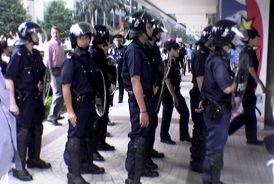 “This section go to the right! The rest go left! No one is to come through!” barked the corporal to his men, clad in full riot gear – truncheons, shields, head gear, and shin guards.
The threat? Four (yes, 4) activists who had assembled outside the Central Provident Fund Building in downtown Singapore to protest against the non-transparent and non-accountable nature of the way the Singapore Government deals with public funds. Two of the protesters were women.
The number of police officers numbered at approximately 40.
Mr Charles Tan, Ms Chee Siok Chin, Ms Monica Kumar, and Mr Yap Keng Ho were wearing T-shirts with the words: “NKF” (National Kidney Foundation), “HDB” (Housing De
velopment Board), “GIC” (Government of Singapore Investment Corporation), “CPF” (Central Provident Fund), “Financial Reserves” – “Be Transparent Now!”
These state-run organisations (NKF is closely associated with the Government) are run in a secretive manner. For example, the GIC (chaired by Mr Lee Kuan Yew, former prime minister and paramount leader of Singapore) uses the country's financial reserves in investments all the world but refuses to give an account for its dealings.
Associate Professor Mukul Asher at the National University of Singapore noted about the funds invested by the GIC: “There is…no transparency or public accountability concerning where these funds are invested.” The Asian Wall Street Journal remarked: “Where do the CPF funds go? No one is exactly sure since the government, amazingly, won’t give the public a precise accounting of how it uses the public’s money.”
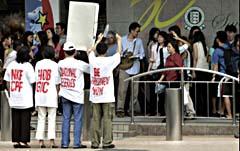 The protest started off with the four activists standing quietly outside the building wearing their T-shirts. After about 30 minutes, two police cars arrived with lights flashing, carrying a few senior officers.
This was followed by a few police vans carrying uniformed officers, including those from the riot squad. After forming up, the officers cordoned off the entrance to the building.
“Who's in charge?” Deputy Superintendent Dominic John Baptist asked the protesters, his hands quivering.
“All of us,” replied Mr Yap Keng Ho.
“I'm ordering all of you to disperse.”
“On what grounds?” asked Ms Chee Siok Chin.
“Public nuisance. Someone called to complain,” the DSP replied.
“But as you can see , we are standing here peacefully and we have not...” Ms Chee started to explain.
“Disperse now! Are you going to be here? Leave!” ordered the officer.
“Sir, can I ask you under what law...” Ms Chee persisted.
“The offence is public nuisance under the Miscellaneous Offences Act. It is a seizable offence, which means you may be arrested.”
The protesters complied and left the area. The police continued to follow them and after a few metres, stopped them and confiscated the T-shirts they were wearing.
“Will we get the T-shirts back?” the protesters enquired. The police didn't bother to reply.
Several questions need to be asked from this episode :
One, did the police have the right to order the protesters to leave especially when there were only four of them? The law clearly states that only five or more people gathered in a public place constitutes an illegal assembly.
Two, did the police see the protesters creating a commotion and making a nuisance of themselves? Throughout the protest all four protesters stood silently until the police started questioning them.
Three, why is the Singapore Government so afraid of four peaceful protesters that it had to send in the riot squad? Signs of insecurity perhaps?
Although the foursome was dispersed by the officer accusing them of causing a public nuisance, a reading of the law would seem to say they did no wrong:
Nuisances
11. —(1) Any person who commits any of the following offences shall be liable on conviction to a fine not exceeding $1,000:
(a) without authority in the case of public property, or without the consent of the owner or occupier in the case of private property, affixes or causes to be affixed any advertisement, bill or notice, or any paper against or upon any building, wall or fence, or writes upon, defaces or marks any such building, wall or fence with chalk or paint, or in any other way;
(b) bathes or washes himself, or any other person, animal or thing on any public road, or in, upon or by the side of any public tank, reservoir, watercourse or stream;
(c) obstructs or causes trouble or inconvenience to a person bathing at any place set apart as a bathing place by wilful intrusion, or by washing any animal at or near that place, or in any other way;
(d) being the owner or person in charge of any animal does not, if the animal dies, dispose of its carcase in such a way as not to be a common nuisance;
(e) places any dead animal on or near any public road;
(f) spits in any coffee shop, market, eating house, school house, theatre or public building, or in any omnibus, railway carriage or other public conveyance, or on any wharf or jetty, or in any public road, or on any five-foot way or sidewalk of any public road, or in any other place to which the public has or may have access;
(g) suffers to be at large any unmuzzled ferocious dog or other animal, or sets on or urges any dog or other animal to attack, worry or put in fear any person or animal.
Listen to what Lee Kuan Yew in 1956, speaking as an opposition PAP member, said to then Chief Minister David Marshall:
"Repression, Sir, is a habit that grows. I am told it is like making love-it is always easier the second time! The first time there may be pangs of conscience, a sense of guilt. But once embarked on this course with constant repetition you get more and more brazen in the attack. All you have to do is to dissolve organizations and societies and banish and detain the key political workers in these societies. Then miraculously everything is tranquil on the surface. Then an intimidated press and the government-controlled radio together can regularly sing your praises, and slowly and steadily the people are made to forget the evil things that have already been done, or if these things are referred to again they're conveniently distorted and distorted with impunity, because there will be no opposition to contradict."
11 Aug 05, Source:www.infoshop.org
“This section go to the right! The rest go left! No one is to come through!” barked the corporal to his men, clad in full riot gear – truncheons, shields, head gear, and shin guards.The threat? Four (yes, 4) activists who had assembled outside the Central Provident Fund Building in downtown Singapore to protest against the non-transparent and non-accountable nature of the way the Singapore Government deals with public funds. Two of the protesters were women.
The number of police officers numbered at approximately 40.
Mr Charles Tan, Ms Chee Siok Chin, Ms Monica Kumar, and Mr Yap Keng Ho were wearing T-shirts with the words: “NKF” (National Kidney Foundation), “HDB” (Housing De
velopment Board), “GIC” (Government of Singapore Investment Corporation), “CPF” (Central Provident Fund), “Financial Reserves” – “Be Transparent Now!”
These state-run organisations (NKF is closely associated with the Government) are run in a secretive manner. For example, the GIC (chaired by Mr Lee Kuan Yew, former prime minister and paramount leader of Singapore) uses the country's financial reserves in investments all the world but refuses to give an account for its dealings.
Associate Professor Mukul Asher at the National University of Singapore noted about the funds invested by the GIC: “There is…no transparency or public accountability concerning where these funds are invested.” The Asian Wall Street Journal remarked: “Where do the CPF funds go? No one is exactly sure since the government, amazingly, won’t give the public a precise accounting of how it uses the public’s money.”
The protest started off with the four activists standing quietly outside the building wearing their T-shirts. After about 30 minutes, two police cars arrived with lights flashing, carrying a few senior officers.This was followed by a few police vans carrying uniformed officers, including those from the riot squad. After forming up, the officers cordoned off the entrance to the building.
“Who's in charge?” Deputy Superintendent Dominic John Baptist asked the protesters, his hands quivering.
“All of us,” replied Mr Yap Keng Ho.
“I'm ordering all of you to disperse.”
“On what grounds?” asked Ms Chee Siok Chin.
“Public nuisance. Someone called to complain,” the DSP replied.
“But as you can see , we are standing here peacefully and we have not...” Ms Chee started to explain.
“Disperse now! Are you going to be here? Leave!” ordered the officer.
“Sir, can I ask you under what law...” Ms Chee persisted.
“The offence is public nuisance under the Miscellaneous Offences Act. It is a seizable offence, which means you may be arrested.”
The protesters complied and left the area. The police continued to follow them and after a few metres, stopped them and confiscated the T-shirts they were wearing.
“Will we get the T-shirts back?” the protesters enquired. The police didn't bother to reply.
Several questions need to be asked from this episode :
One, did the police have the right to order the protesters to leave especially when there were only four of them? The law clearly states that only five or more people gathered in a public place constitutes an illegal assembly.
Two, did the police see the protesters creating a commotion and making a nuisance of themselves? Throughout the protest all four protesters stood silently until the police started questioning them.
Three, why is the Singapore Government so afraid of four peaceful protesters that it had to send in the riot squad? Signs of insecurity perhaps?
Although the foursome was dispersed by the officer accusing them of causing a public nuisance, a reading of the law would seem to say they did no wrong:
Nuisances
11. —(1) Any person who commits any of the following offences shall be liable on conviction to a fine not exceeding $1,000:
(a) without authority in the case of public property, or without the consent of the owner or occupier in the case of private property, affixes or causes to be affixed any advertisement, bill or notice, or any paper against or upon any building, wall or fence, or writes upon, defaces or marks any such building, wall or fence with chalk or paint, or in any other way;
(b) bathes or washes himself, or any other person, animal or thing on any public road, or in, upon or by the side of any public tank, reservoir, watercourse or stream;
(c) obstructs or causes trouble or inconvenience to a person bathing at any place set apart as a bathing place by wilful intrusion, or by washing any animal at or near that place, or in any other way;
(d) being the owner or person in charge of any animal does not, if the animal dies, dispose of its carcase in such a way as not to be a common nuisance;
(e) places any dead animal on or near any public road;
(f) spits in any coffee shop, market, eating house, school house, theatre or public building, or in any omnibus, railway carriage or other public conveyance, or on any wharf or jetty, or in any public road, or on any five-foot way or sidewalk of any public road, or in any other place to which the public has or may have access;
(g) suffers to be at large any unmuzzled ferocious dog or other animal, or sets on or urges any dog or other animal to attack, worry or put in fear any person or animal.
Listen to what Lee Kuan Yew in 1956, speaking as an opposition PAP member, said to then Chief Minister David Marshall:
"Repression, Sir, is a habit that grows. I am told it is like making love-it is always easier the second time! The first time there may be pangs of conscience, a sense of guilt. But once embarked on this course with constant repetition you get more and more brazen in the attack. All you have to do is to dissolve organizations and societies and banish and detain the key political workers in these societies. Then miraculously everything is tranquil on the surface. Then an intimidated press and the government-controlled radio together can regularly sing your praises, and slowly and steadily the people are made to forget the evil things that have already been done, or if these things are referred to again they're conveniently distorted and distorted with impunity, because there will be no opposition to contradict."

Subscribe to:
Posts (Atom)