Thursday, July 14, 2005

The Aftermath Of Disgust

SO DISGUSTING
By Low Ching Ling and Celine Lim
The New Paper, July 14, 2005
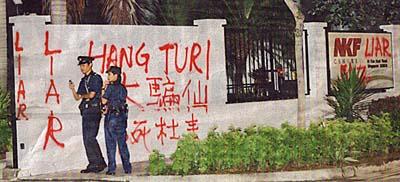

The vile words were splashed in bold red on the white walls of the building.

In what was a bold public display of disgust against the National Kidney Foundation and CEO T T Durai, someone - or some people - sprayed paint on the outer walls of its Kim Keat Road headquarters early this morning.

The New Paper rushed down at about 6am after a reader noticed the vandalism and called our hotline. A wall of red graffiti greeted us. On one part of the outer front wall were the words 'NKF=liar' written in English, and 'big liar' in Chinese - all spray-painted in bold. The word 'liar' was also written in bold on every alternate pillar. The culprits also vandalised the side of the building with the words 'Save Singapore' and 'Liar'.

A motorcyclist who was delivering newspapers was overheard uttering: 'Now the whole world knows.'

Said police spokesman Debbie See: 'At 5.20am, the police received a call about graffiti on the walls of the (NKF) building. 'We're still investigating.'

The graffiti invited curious stares from morning joggers and passers-by. An SBS Transit bus driver even stopped his bus for about a minute to look. A jogger who declined to be named said: 'The people who did this are very daring. The building is along the main road and they might have been seen.'

Cabby C W Heng, 50, who lives nearby, felt it was a juvenile act.
'They destroyed the property and the NKF will have to use public funds to fix it. If they want to express their unhappiness, they can write to the newspaper forum or call the radio station. It's a barbaric act.'

NKF spokesman Michelle Ang said security guards were informed about the vandalism some time after 5am by police officers. She had left the building some time after midnight and did not see any
graffiti then. The graffiti has since been removed, but Ms Ang was not able to say when and by whom.

She said: 'It's very unfortunate this has happened. Whatever the public read about the court proceedings is only one side of the story. 'We really hope they won't forget what the NKF has achieved in the provision of dialysis and in helping kidney patients over the years.' Ms Ang confirmed that some donors are planning to cancel their contributions to NKF. The staff have also received abusive calls from angry donors.

Cries of anger and threats to cancel donations to NKF rang out in one Shenton Way office yesterday when the news broke of Mr Durai being paid $25,000 a month. Mrs D Sim, 50, an administrator, said: 'Everybody in my office wanted to stop their monthly Giro payments to NKF as we were so angry.'

We spoke to nine people and the general feeling was that the public's trust in NKF has been badly shaken. At least five were upset with Mr Durai's salary and how NKF spends its money. Property agent Ray Lee, 40, said: 'NKF is always educating the public that every single cent counts. But I didn't know how the money I donated was used. Now it has come to light.'

Despite feeling disgruntled over Mr Durai's 10-to-12-month bonus, Mr Lim M O, 50, a businessman, will continue his yearly donations of $50 as his late mother had kidney problems.

Mr Saravanan M Govindasamy, 35, a prisons officer, will wait for NKF's explanation before deciding his next move. He said: 'We can't penalise the needy, sick people out there who need our donations.'

On Day Three 3,800 members of the public withdrew their donations from the NKF, and an online petition demanding the resignation of TT Durai drew 30,000 signatures on the first day.

On Day Four, the beleaguered NKF CEO and his entire board resigned. Durai, true to his characteristic liberty with facts, told reporters he was stepping down after 30 years for new blood to take over. The surprise element was that Patron Mrs Goh Chok Tong also decided to step down, adding fodder to the rumour mill.

Tuesday, July 12, 2005

Skeletons in NKF Cupboard

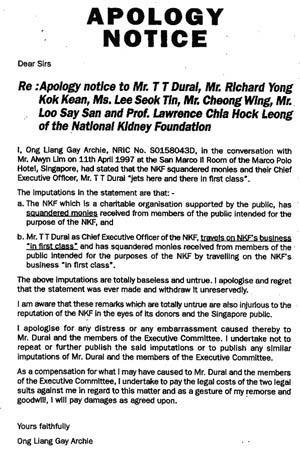
On April 11 1997, in a casual conversation with Mr Alwyn Lim (then NKF volunteer and current Vice-President) at the former Marco Polo Hotel, Mr Archie Ong Liang Gay, a former volunteer of the National Kidney Foundation (NKF) and real estate consultant, commented that NKF "squandered monies" and that Mr T T Durai, its Chief Executive Officer, "jets here and there in first class".

Durai and five members of the NKF Executive Committee successfully sued Mr Ong for slander on the basis that his remarks could damage the credibility of NKF and Durai, its CEO since 1992.

Mr Ong, in a public apology published on 18 April 1998, had to withdraw his remarks which allegedly implied that:

1. The NKF, which is a charitable organisation supported by the public, has squandered monies received from members of the public intended for the purpose of the NKF; and

2. Mr Durai as CEO of the NKF, travels on NKF business in first class and thus squanders NKF monies.

As compensation, Mr Ong had to pay the legal costs of the two suits against him. In another case in December 1998 NKF also took legal action in Singapore courts against aero-modelling instructor Piragasam Singaravelu, who said he had seen Durai in the Singapore Airlines (SIA)first-class cabin. Mr Singaravelu had to pay $22,000 in damages and another $10,000 for the apology notices.

Flies First ClassOn Day One of NKF's defamation suit against Singapore Press Holdings (SPH), for an article by senior correspondent Susan Long published on April 19 2004, which stated that a $900 gold-plated tap had been installed and later replaced in the private bathroom of his penthouse office suite, on the 12th floor of the $21 million building, Mr Durai, under questioning by Senior Counsel Davinder Singh, admitted he had flown first class on some airlines.

His explanation: The NKF board allowed this as long as he did not bust the Singapore Airlines business-class rate.

Mr Singh countered: "Isn't it your duty as a trustee of people's monies to make sure that you get best value on a business-class seat instead of deploying this clever tactic... using it for first class on another plane?"

Mr Durai replied: "This is a decision made by the board. I used the entitlement." The entitlement, he added, kicked in only in the past two years. Previously, when he flew first class, he had paid the difference out of his own pocket, he maintained.

Mr Singh noted that although he now flew first class, Mr Durai did not correct his chairman Richard Yong's assertion in the April 19 2004 article that "there is no such thing as first-class travel".

"The reason you hide the truth is because you know that that is the wrong thing to do, using people's money, and you know that is mismanagement of donations."

Mr Durai was asked if he should now "do the right thing" by the two individuals who had paid him damages and costs for saying what he had now admitted in court. He said no, sticking to his claim that at that time, he did not travel first class using NKF funds and when he did so, he paid the difference himself.

The NKF, which is entirely dependent on public funds, offers dialysis treatment to kidney patients. Two out of every three Singaporeans contribute to it.

Gasps could be heard in the courtroom when it was revealed that on top of his $25,000 a month salary, the NKF CEO also received 10 to 12 months in yearly bonuses. That makes his annual salary between $550,000 and $600,000, or $1.8 million in total over the past three years, 2002 to 2004, a period when thousands of Singaporeans lost their jobs due to the economic recession and disastrous job retructuring exercises.

Mr Singh told the court he had on previous occasions asked Mr Durai three times, twice in court, to disclose this closedly guarded secret of the National Kidney Foundation. Mr Durai argued that he was not required by law to tell the public what he earned, even though he conceded that they paid his salary. Also, he wanted to protect his personal privacy.

Mr Singh asked: "The man who earns $1,000 a month who donates $50... every month thinking that it is going to save lives, should they not know that that is the kind of money you earn?"

Replied Mr Durai: "I don't see the need for him to know." He denied Mr Singh's charge that he refused to disclose his salary as he knew he would lose moral authority with donors.

Singaporeans are familiar with the glitzy NKF Fund raising charity shows which feature television personalities in "death defying" acts like climbing on a ladder of swords. But NKF's bread and butter is the $3 to $5 monthly Giro donations from about one million ordinary Singaporeans. With such a big base of small heartland givers - its website says nearly two out of every three Singaporeans are donors - the pennies add up. Incredulity greeted news of its amazing $189 million in reserves when it was revealed during the 35th anniversary celebration on April 7, 2004.

Even when administering its dialysis and patient rehabilitation programmes, the NKF approach is not without controversy.

NKF demands that patients co-pay for dialysis, hold down jobs and stick to their diet - or pay more. Patients' fees, for example, are reduced by $50 to $100 as an incentive, if they find a job, get promoted, tie the knot, give birth, or even when their school-going children score A grades.

Each patient is admitted for life - or until they are lucky enough to get a kidney transplant. Chairman Mr Yong says patients themselves pay from nothing to $800 each month for three-times-a-week dialysis which would cost at least $3,000 each month outside.

As Mr Yong says: "We don't dialyse them to go home and sleep. We want them to have jobs, bring home the bacon, contribute to the economy, have normal relations with their spouses and their children to do well in school. We say openly to them: 'If you want to die, go and die by yourself; don't come to us'."

As a result, 93 per cent of NKF dialysis patients work, support their families and lead productive lives, compared to less than 60 per cent worldwide.

The general philosophy, at least for patients, is: No free rides.

On the second day of hearing, TT Durai withdrew his suit against SPH and ended the court case dramatically when more revelations put to challenge the transparency that NKF claims to maintain:
- Durai had 4 to 5 paid directorships (each paying up to $25,000 per annum) not disclosed to the board;
- Durai had undisclosed commercial dealings with an ex-NKF female employee and current board member whose company he invested in sold call centre services to NKF;
- Durai admitted NKF only had 2000 patients, not bothering to correct the 3000 figure used by NKF;
- Durai had 8 cars at his disposal, yet the road tax, repairs and maintenance of his private Mercedes 200 was charged to NKF.